Commercial & industrialUpdated 21 July 202610 min read
Data, comms and extra-low voltage beside power
Shared trays, PoE cameras and access-control cables are now ordinary on commercial jobs, and so are the defects they leave in a live board. Segregation, fire-rated penetrations, licensing boundaries and a hard rule about who may terminate in a switchboard will keep a data job from becoming an electrical incident.
By Daniel Okonkwo
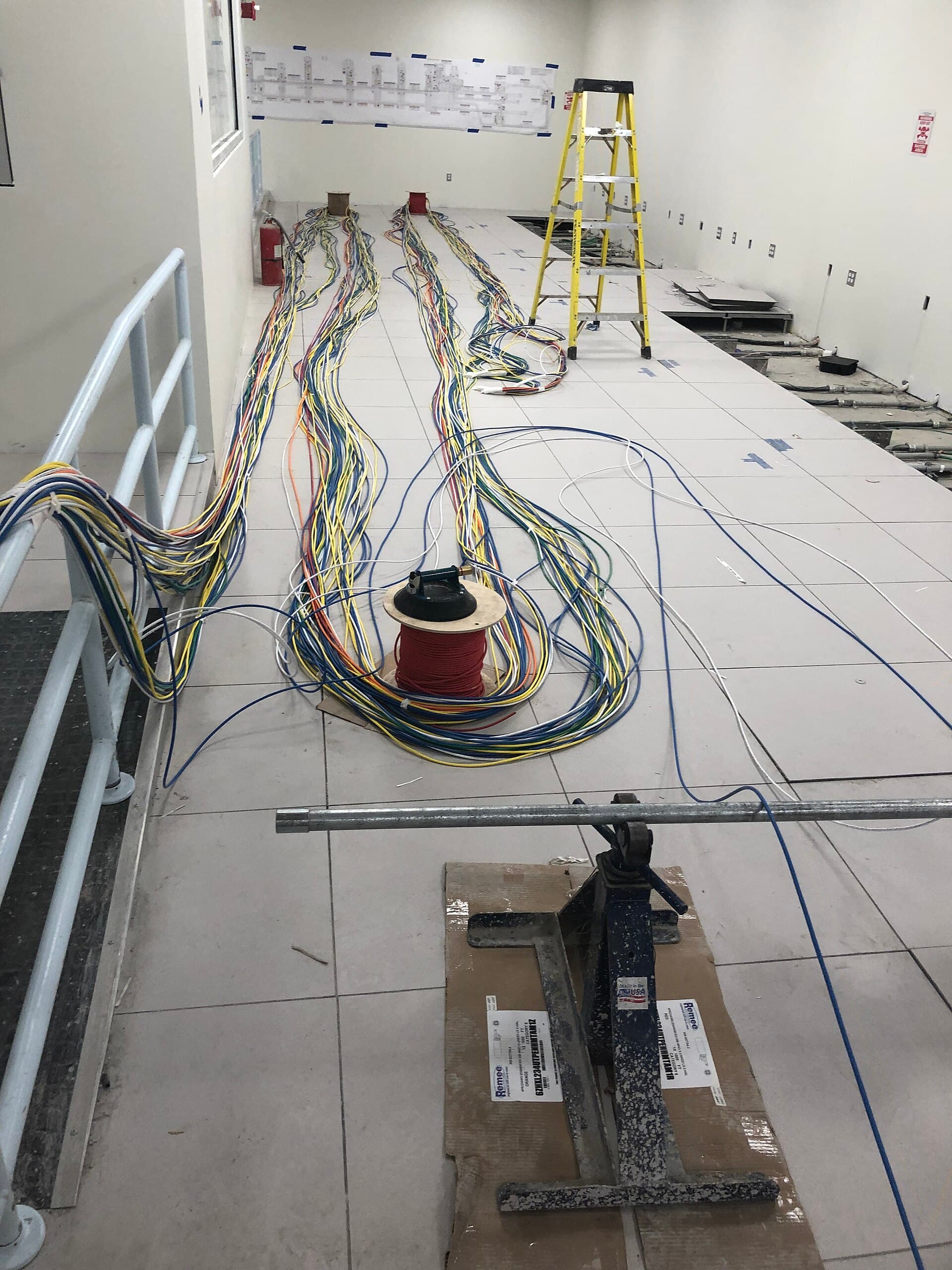
The data subcontractor will tell you they are not doing electrical work. Then you will find a 240 volt plug pack jammed in a switchboard, a bundle of Cat 6 dressed over a bare earth bar, and an access-control cable that has been stapled to a fire door. Extra-low voltage has a way of arriving on site as if the Wiring Rules had been paused for it.
They have not. AS/NZS 3000 still governs how low voltage and extra-low voltage share a building. The Australian Communications and Media Authority still governs customer cabling. Your state or territory still governs who may do electrical work. Those three systems overlap in a ceiling space, and they do not cancel each other.
This is ordinary commercial work. It belongs in the commercial and industrial hub because that is where the trays, the tenant boards and the “just run it with the power” conversations live.
Segregation is a clause, not a courtesy
AS/NZS 3000 requires low-voltage cables and other services to be arranged so that the extra-low voltage system is not exposed to low voltage, and so that a fault in one does not become a surprise in the other. The acceptable methods are in the Rules: separation by distance, a barrier, or a cable sheath that the standard accepts. “They are both in the tray, she will be right” is not one of the methods.
Shared cable trays are fine when they are designed as shared trays. They are not fine when a data bundle is laid on top of TPS because the tray is full and Friday is close. Mechanical damage, heat, and the simple inability to identify a circuit at the next fit-out are all reasons to refuse a mess even when the millimetres of separation could be argued.
In ceilings, keep power and data on their own routes where you can. Where you cannot, use a divider or a separate basket. Do not let a data installer use your conduit as a draw wire for a HDMI lead. Do not let your apprentice use a data ring as a convenient earth.
Segregation also means you can isolate one system without taking the other with it. A tenant who wants the cameras left on while you isolate the power for a board change needs a power supply that does not live on the circuit you are about to kill — or they need a plan. That plan is your job to raise, not theirs to invent at 6am.
Shared trays, risers and the next person’s problem
A vertical riser in a two-storey shop is a small version of a commercial services shaft. Fire stopping, support, and the order of services all matter. Power at the bottom, data in the middle, wet services nowhere near either if you can help it, is a habit that prevents stupid faults. It is not a substitute for the NCC and the fire engineer’s detail.
Support the cables. A data bundle hanging off a power conduit saddle will saw itself through in a year. A power circuit lying on a sharp tray edge will do the same. AS/NZS 3000’s mechanical protection and support requirements apply to the cables you installed, including the ones you “only tagged along with”.
Identify everything. A black 2-pair on an access-control lock looks like a dozen other black 2-pairs. Sleeve it, label both ends, and put it on a drawing that someone will still have when the lock fails. The same goes for PoE runs that feed a camera three tenancies away. If you cannot name it, you cannot isolate it.
If the tray is already a nest, photograph it before you add to it. Then decide whether adding to it is professional. Sometimes the right work is a second tray and a variation. The client who refused the variation will still call you when the first person to fault-find cuts the wrong cable.
PoE, cameras and the myth of harmless voltage
Power over Ethernet is extra-low voltage at the camera and low voltage at the switch. The switch needs a circuit, an isolator, ventilation and a clean earth. It does not need to sit in the bottom of a distribution board on a powerboard that was bought at a supermarket.
PoE also carries enough energy, on longer runs and higher types, to surprise people who were told “it’s only data”. Treat damaged cables, crushed terminations and water in an external camera box as electrical faults. Water in a junction that also holds a 240 volt circuit is a segregation failure, not a comms warranty claim.
Camera installs love soffits, fascia and the outside of a coolroom. UV, heat and condensation kill cheap cable. Use the cable the environment needs, not the leftover box of riser-rated Cat 6 that was in the van. External rated, gel-filled or a proper enclosure — pick one that matches the weather you actually have, which in most of Australia includes a summer that cooks plastics.
If the cameras are part of a security system that the client will rely on as a control, write down where the power comes from and what happens when you isolate the tenancy. A recorder that dies every time the lighting circuit is isolated is a design defect you can still prevent on day one.
Access control, alarms and the door that must still work in a fire
Access-control locks, request-to-exit buttons, maglocks and the fire-trip that drops them are a mix of extra-low voltage, low voltage and a building-control obligation. A maglock that stays locked when the fire system tells it to drop is not an electrical nicety. It is an egress defect.
Find the fire interface before you land the lock. If there is a fire contractor, talk to them. If there is not, do not invent a relay logic you cannot later explain. The NCC and the fire-safety engineer, not a YouTube locksmith, decide how a door behaves in alarm.
Battery-backed supplies for access control need to be installed as electrical equipment: ventilated, labelled, isolated, and not balanced on the cable tray. The battery is a chemical fire if you cook it. The mains side of the supply is ordinary low-voltage work.
Doorbells, intercoms and “we just need a strike on the back gate” are how unlicensed people talk themselves into a live circuit. If the strike is fed from a plug pack, the outlet that feeds the plug pack is still yours to put in a sensible place. If someone wants to tap a lighting circuit in the ceiling for a transformer, that is electrical work. See who may do it.
Who is licensed for what
This is the part of the job that gets people fined.
Electrical work — installing, altering, repairing or maintaining electrical equipment that is part of an electrical installation — requires the electrical licence your state or territory issues. Restricted electrical licences exist for some trades and some tasks. They are narrow. They are not a general permission to work in a switchboard because “it is only the ELV side”.
Customer cabling — the telephone, data and some extra-low voltage communications work that falls under the ACMA cabling provider rules — requires registration in the right category. A registered cabler is not, by that registration alone, a licensed electrician. A licensed electrician is not, by that licence alone, free of the cabling rules when they are terminating a structured cabling plant for a customer.
On a mixed job you need both competencies, or two people. The electrical contractor owns the low-voltage supply, the board, the segregation, the earthing, and any ELV that is installed as part of the electrical installation. The cabler owns the structured cabling that sits under the ACMA rules. Where those worlds meet — a powered patch panel, a PoE switch, a lock power supply — write down who is doing the termination and under which licence.
Apprentices and trades assistants do not become licensed by proximity. If they are pulling data beside live power, the supervision is the same conversation you have on any electrical job. A SWMS that pretends the ceiling is dead because the work is “comms” is a SWMS that will not survive a serious incident.
Do not let the data subcontractor terminate in a live board. Not on a DIN-rail power supply they brought in their backpack. Not on a spare breaker they “only need for a minute”. Give them a dedicated ELV enclosure, a socket-outlet you have installed and certified, or a dead, isolated section you have made safe under your own isolation. If they need 240 volts, you land it. That is not preciousness. That is the licence.
Fire-rated penetrations
Every hole you make in a fire-rated wall or floor is a hole you have to put back. The NCC treats fire-resisting construction as a system. A handful of ordinary expanding foam, a smear of acrylic, or a pile of rockwool stuffed with optimism is not that system.
Use the penetration product that matches the wall — plasterboard, concrete, shaft wall — and the services that pass through it. Some systems allow mixed services. Some do not. Some require a steel can, a specific collar, or a minimum separation between pipes and cables. Read the installation sheet on site, not in the trade-counter queue.
Data installers cut neat holes. They are less reliable at putting them back. If they are on your site under your contract, the penetration is your defect when the building surveyor finds it. Price the fire stopping. Watch it go in. Photograph it with a tape against the wall so the later argument has a picture.
Do not run extra services through a penetration that was certified for one conduit. Do not drop a second data bundle through a gap beside a fire collar and call it close enough. The next inspector will not be in a hurry.
Labelling, records and the live-board rule in practice
A commercial comms job that leaves no drawing is a future isolation failure. Minimum records: cable identity at both ends; the circuit that feeds each power supply; the location of every PoE switch and lock supply; the fire interface for doors; and a photograph of the inside of any enclosure you landed.
Label the enclosure, not just the cable. “ACCESS CONTROL PSU — ISOLATE AT DB-1 CKT 18” is a sentence that prevents someone from opening a live board to find a plug pack.
The live-board rule, again, because it is the one that gets ignored when the project manager is hovering.
The data subcontractor does not open the electrical switchboard.
If a power supply must live in that room, it lives in its own enclosure or in a clearly segregated, shrouded section that you have arranged.
If they need a circuit, you install it, test it and certify it.
If they have already been in the board when you arrive, you treat the board as unknown. You isolate, you inspect, you test. You do not assume their termination is safe because the cameras are working.
A working camera is not a test result.
On small commercial three-phase sites the board is already doing too many jobs. Adding an unsupervised comms termination is how a tidy MEN becomes a bird’s nest.
Data and power on the same job: a contractor’s checklist
- Decide, in writing, who is doing electrical work and who is doing customer cabling. Check licences and ACMA registration before they start.
- Plan segregation in the tray, the ceiling and the riser. Distance, barrier or acceptable sheath — pick one the Rules recognise.
- Give every PoE switch and lock power supply a proper circuit, an isolator and an enclosure that is not the main switchboard.
- Keep data subcontractors out of live boards. You land the 240 volts.
- Trace the fire interface on every electrically locked egress door before you terminate the lock.
- Reinstate every fire-rated penetration with a listed system. Photograph it.
- Label both ends of every ELV run and the circuit that feeds its power supply.
- Support and protect mixed services so the next person can isolate one without cutting the other.
- Update the switchboard legend if you added circuits for comms equipment.
- Test insulation and earth continuity on the electrical work you did. A ping on a network is not an electrical test.
The buildings that come up clean on the next fit-out are the ones where someone treated data as a service with rules, not as a softer kind of string. Extra-low voltage is still a voltage. The board is still a board. The licence is still the licence.
Questions contractors ask
- Can a registered cabling provider terminate inside a live electrical switchboard?
- Customer cabling registration under the ACMA rules is not an electrical licence. Opening a live board, landing a power supply on a circuit breaker, or dressing cables on a busbar is electrical work. If the data subcontractor does not hold the right electrical licence for that state, they stay out of the board. You give them an ELV enclosure or a segregated section that is safe to work in.
- Does PoE count as electrical work?
- Extra-low voltage is still part of an electrical installation when it is wired as one, and AS/NZS 3000 still cares about segregation, protection and earthing. The power source — a switch, an injector, a licensed-in circuit — is usually low voltage on the supply side. Treat the whole path with the licensing rules of the state you are standing in, not with a shrug because the camera end is 48 volts.
- Who is responsible for a fire-rated penetration that has data and power in it?
- Whoever opened it owns the reinstatement unless the contract says otherwise in writing. A handful of expanding foam is not a fire-rated system. Use the system the wall or floor was certified with, and do not mix services in a way that the penetration detail does not allow.