Residential electricalUpdated 8 June 20269 min read
Switchboard upgrades in older Australian homes
Older Australian switchboards fail in predictable ways, and a fuse swap is rarely the whole job. This piece walks licensed electricians through asbestos panels, MEN, meter isolation, load assessment and the conversation with the DNSP before anything is left live in the old box.
By Tom Rafter
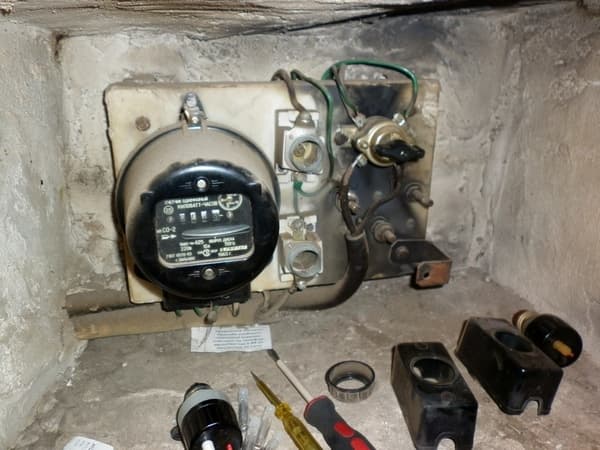
A 1968 weatherboard with a porcelain fuse carrier and a handwritten circuit list is still a working Australian installation. It is also the job that produces the most arguments after the invoice, because the owner asked for "a new switchboard" and the electrician discovered asbestos, no MEN link, a 63 A service that will not cover the induction cooktop already sitting in the kitchen, and a meter panel the DNSP will not let you open on a Friday afternoon.
This is residential work. It is not a product demo. The Wiring Rules, the National Construction Code where it touches the electrical installation, and the distributor's service and installation rules all apply at once. If you need the clause-level reading of isolation, earthing and RCD protection, start with AS/NZS 3000 for contractors and then come back to the board in front of you.
What you are actually looking at
Rewirable fuses and the backing nobody wants to name
Older Australian boards fail in families. Rewirable porcelain fuses are the obvious ones: no residual-current protection, slow operation on earth faults, and a long history of the wrong fuse wire being wrapped around the carrier because someone lost the 15 A reel. Ceramic high-rupturing-capacity fuses are better than cotton, but they still sit on a chassis that was never designed for a row of RCDs, a lockable main switch and a solar generation label.
The backing is the part that injures people who treat the job as a Saturday fuse swap. Asbestos-cement panels were ordinary in domestic switchboards through the 1960s, 1970s and into the 1980s. Grey, painted, scored, or covered with stickers — treat an unidentified panel as asbestos-containing material until a competent person says otherwise. Do not notch it for a wider chassis. Do not drill a new gland. Do not grind off the old labels. Photograph it, isolate, and decide whether the whole assembly comes out as a unit under the asbestos rules that apply on that site.
Meter panels add a second politics. The installation may have the main switch, the MEN link and the meter on one piece of timber, or a network meter panel and a consumer mains run to a rusty distribution board in the laundry. You cannot "tidy" that arrangement without knowing who owns which screws. The DNSP owns the metering and the service equipment. You own everything on the consumer side once you accept the job. Mixing those two sentences is how electricians end up explaining a broken meter seal to an auditor.
MEN, earthing and the lie of the extra stake
The multiple earthed neutral system is not optional folklore. The MEN connection belongs at the main earthing bar of the main switchboard. Older homes present three bad variants: no MEN link at all and a hopeful earth stake; a MEN that lived on the meter panel you are about to abandon; or two MEN links after someone "improved" the earth during a shed fit-off.
An extra electrode does not repair a missing MEN. A missing main earth conductor is not solved by clipping a green cable to a water pipe and calling it bonding. If you move the main switchboard, you move or remake the MEN at the new main board and you prove the earth-fault loop and continuity before you energise. You also confirm that the incoming consumer mains and the main neutral are fit for the new arrangement. A pretty new DIN rail on a rotten main neutral is a future open-neutral fire.
Solar and batteries make this worse, not better. A generation source on an old board with a confused earth-neutral arrangement is how you get live metal after a network outage. If the same house is about to take PV, read inverter and switchboard changes when PV lands on an old board before you price a "solar-ready" enclosure that cannot carry the inverter current on the busbar.
Meter isolation is a conversation, not a habit
Every network has a written process for when a licensed electrician may isolate, when the distributor must attend, and what happens to metering when you relocate a board. Ausgrid, Endeavour Energy, Essential Energy, Energex, Ergon Energy, CitiPower, Powercor, United Energy, Jemena, AusNet, SA Power Networks, Western Power, Horizon Power, TasNetworks, Evoenergy and Power and Water do not run the same playbook. The street address decides the rule, not the brand of chassis you prefer.
Do the notification first. Service fuse size, supply capacity, overhead or underground service, whether the meter can stay, whether a solar or two-element meter is already programmed, and whether the consumer mains must be replaced are all questions that change the quote. A load assessment that ignores the service fuse is a fiction. If the network will not lift the fuse above 63 A, the 14 kW ducted unit and the 7 kW cooktop are a diversity conversation, not a bigger main switch.
Do not leave the old meter panel as a live junction box "until the plasterer is finished". If tails remain, they are part of the installation. They are labelled, enclosed, and either commissioned or removed. An open neutral in a dead-looking fuse box is still an open neutral.
Load assessment before you order the chassis
Maximum demand in AS/NZS 3000 is the method. A photo of the old 63 A main switch is not the method. Walk the house. Count fixed cooking, air-conditioning, storage water heating, pool equipment, hard-wired EV charging, and any generation. Ask what is coming in the next renovation, because the same owner who wants a cheap board this month will want a cooktop next month and will not want to pay for the chassis twice.
Diversity is allowed. Wishful thinking is not. If the existing consumer mains or the service arrangement cannot support the assessed demand, you write that in the quote as a network and mains problem, not as a surprise variation after the old board is in the bin.
Kitchen and bathroom renovations are the usual trigger. A range circuit, multiple RCDs and a steam-room extract on a four-way fuse box is how kitchen and bathroom electrical renovations turn into this article. Price the board when you price the wet areas. Do not pretend the existing porcelain carriers will accept the new final subcircuits.
Photograph existing, then photograph as-built
Two sets of photographs belong in the job file. The first is the existing arrangement before you touch it: the whole enclosure, the incoming tails, the MEN or its absence, the meter seals, the backing material, every faded circuit label, and the route of the consumer mains. Those photos protect you when the owner later says the old board "was fine" and when an asbestos question arrives from the next tradesperson.
The second set is as-built: main switch, MEN link, earth electrode connection, RCD and circuit schedule, generation labels if any, isolation points, and the closed enclosure with the circuit legend readable. The certificate of compliance is not a substitute for this. Inspectors and future electricians should be able to see what you left, not guess from a generic schedule that says "power" six times.
If you found asbestos, the photographs sit with the asbestos documentation. If you found a missing earth, the photographs sit with the test results. If the DNSP changed the meter, photograph the new metering arrangement as well. None of this is theatre. It is how you demonstrate that the installation you certified is the installation on the wall.
Talking to the DNSP without wasting a week
Call or portal-lodge with facts. Address, National Metering Identifier if you have it, proposed main-switch rating, whether you are relocating the board, whether generation or an EV charger is part of the same visit, and the date you need isolation. Do not ask the control room to "just pull the fuse" as a substitute for a documented request.
Ask what they will require for the new location: working space, height, fire rating of the backing, weatherproofing if the board is moving from a hallway to an external wall, and whether a meter isolation device is being fitted. External boards in coastal or western-sun locations need an enclosure that will still close in five years, not a bargain indoor chassis in a wet alcove.
If the job includes a retailer-led meter exchange, sequence it. There is no point completing a beautiful consumer board and then discovering the metering panel must be rebuilt a fortnight later. Write the sequence into the quote so the owner understands why the power is off once, or why it is off twice.
What not to leave live in the old box
The old enclosure is the part of the job that gets rushed. Do not leave it as a live coffin.
- Do not leave rewirable carriers energised "for the shed" with no schedule and no RCD.
- Do not leave abandoned active and neutral tails taped in the back of the box.
- Do not leave a second, unofficial MEN on the old panel.
- Do not leave solar or inverter conductors landed on an isolated but still connected fuseway.
- Do not leave the old main switch in parallel with the new one.
- Do not leave a circuit that you could not identify. Isolate it, prove it, or cut it dead and record it.
If the enclosure is staying as a junction only, it is converted properly: barriers, labels, no exposed live parts, and no fuse carriers that look like they still do something. If it is coming out, it comes out. A half-dead fuse box on a kitchen wall is how the next apprentice gets a shock during a "simple GPO".
Testing that belongs on the certificate
Insulation resistance, earth-fault loop impedance, RCD trip times and current, polarity, and continuity of the earthing system are not optional extras on a board replacement. Test the final subcircuits you disturbed and the ones you did not, because you have just been inside the heart of the installation. A lighting circuit that "always worked" can show a nicked neutral once you move the tails.
Prove the MEN. Prove the main earth. Prove that the main switch isolates what the label says it isolates. If the house has generation, prove that the shutdown sequence matches the labels you fitted. Energise in an order you can defend: visual, dead testing, then live testing, then the owner's walk-through of the circuit schedule.
Job-site checklist
- Confirm licence class, the state or territory instrument, and the DNSP for the address before you quote.
- Photograph the existing board, meter seals, incoming tails, backing material and circuit identification.
- Treat unidentified switchboard panels as asbestos-containing until cleared. Do not drill or notch them.
- Complete a written maximum-demand assessment, including cooking, air-conditioning, water heating, pool plant, EV charging and generation.
- Lodge isolation and metering notifications with the DNSP. Do not operate network equipment outside their rules.
- Confirm consumer mains size, condition and routing before you order the new assembly.
- Provide a lockable main switch, correctly located MEN link, main earth, and RCD protection for final subcircuits as required by AS/NZS 3000.
- Fit a durable circuit schedule. Do not rely on a text message to the owner.
- Remove or convert the old enclosure so that nothing live remains undocumented.
- Photograph the as-built arrangement and keep it with the certificate of compliance and test results.
- Walk the owner through isolation, the main switch, and what not to reset without calling you.
A board upgrade is one of the few domestic jobs where the owner can see that they bought something. That visibility is useful. It is also why they will photograph your work and send it to the next electrician. Leave an installation that another licence holder can understand, that the DNSP will accept, and that you can stand behind if the old fuse box later turns up in a dispute about asbestos or a missing earth.
Questions contractors ask
- Can I just replace the rewirable fuses with circuit breakers and leave the old enclosure?
- Sometimes the enclosure, backing and incoming arrangement will accept a modern chassis. Often they will not. If the board cannot take RCD protection, a correct MEN link, adequate cabling space and a lockable main switch, you are specifying a new assembly, not a fuse conversion.
- Who isolates the meter on a domestic upgrade?
- The meter and the service fuse sit on the network side of the installation. Follow the DNSP's isolation and notification rules for that street. Do not pull a meter, cut a seal or operate a network device because the homeowner is in a hurry.
- Do I have to upgrade the board if the only request is a new air-conditioner circuit?
- You still have to leave the installation safe and compliant for the work you do. If the existing board cannot protect the new final subcircuit with an RCD, cannot carry the revised maximum demand, or has a defective earth-neutral arrangement, the air-conditioner quote becomes a board-upgrade quote.