Commercial & industrialUpdated 31 March 202611 min read
Temporary construction-site power that will not fail the first wet week
Construction wiring is a different installation from the permanent one that will replace it, and AS/NZS 3012 is the book that says so. Site sheds, RCDs, generators and the question of who owns the board when the builder moves it are where temporary supplies fail — usually in the rain.
By Helen Wu
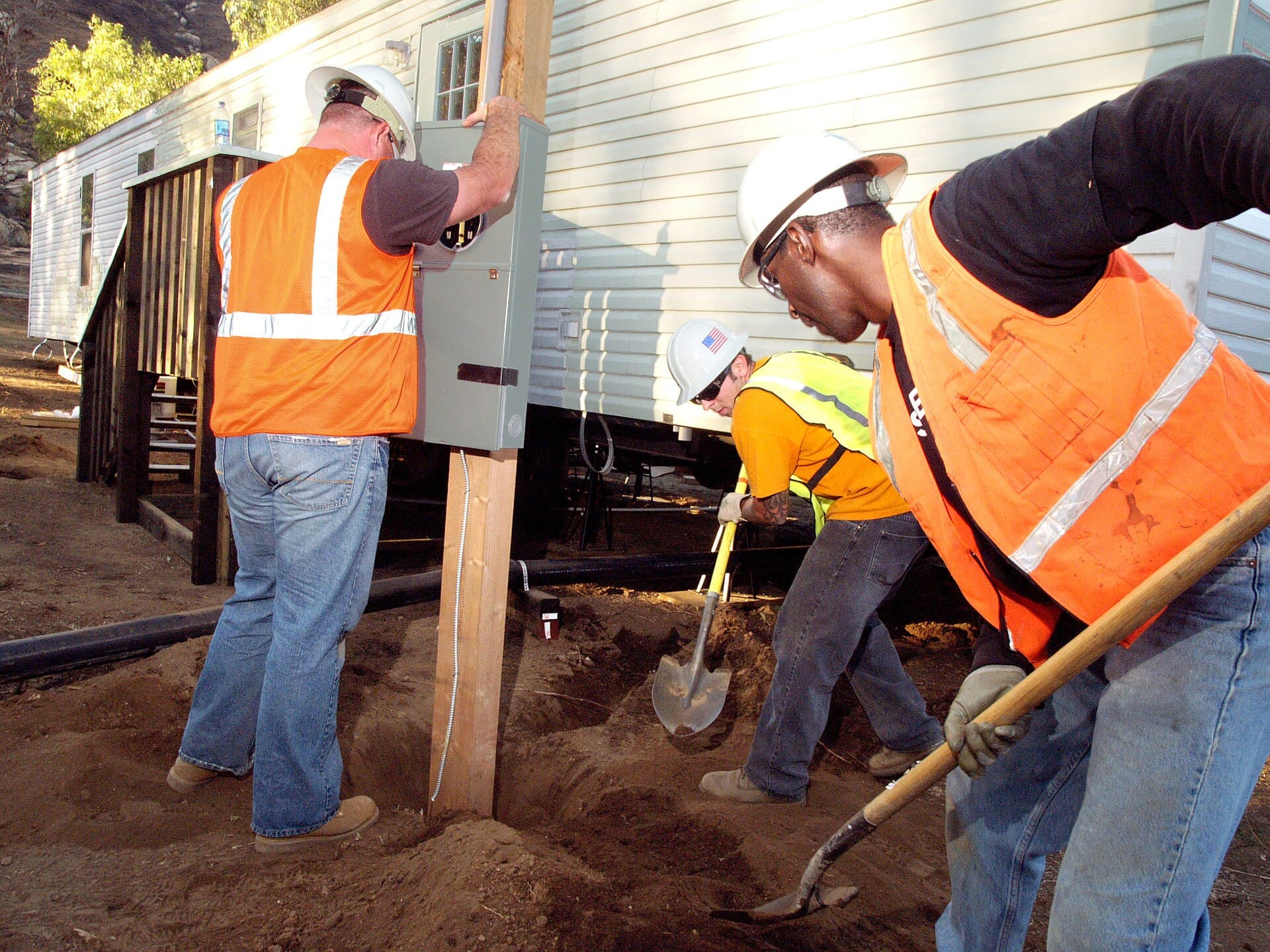
The first wet week is the examination. Cable that was laid across a path is now in a puddle. A board that was level on Monday is standing in clay. An extension lead that was a temporary measure is feeding a site shed, a saw bench and someone’s lunchbox charger. AS/NZS 3012 exists because construction sites are not unfinished houses. They are workplaces with moving plant, unskilled hands on tools, and water.
If you only remember one sentence from this piece, remember this: construction wiring is not permanent wiring that you have not dressed yet. It is a class of installation with its own standard. Read the current AS/NZS 3012 before you quote, and again before you energise. Editions change. Inspection intervals, marking, and the detail of RCD requirements are not things this journal will invent for you and pretend are eternal.
The rest of the commercial and industrial work on a project will arrive later. The temporary supply is what the carpenters will live on until then. It is also what an inspector from the electrical safety office, or a WHS inspector, will look at first if someone is hurt.
What AS/NZS 3012 is asking of you
AS/NZS 3000 still applies. AS/NZS 3012 adds the construction-and-demolition overlay: how you assemble, protect, inspect and identify the wiring that exists only because there is a site. It covers construction wiring, switchboards used for construction, socket-outlet assemblies, lighting, and the conditions that make a construction site different from a completed building.
Use the current text. Do not rely on a photocopied page in the glovebox or a memory of “three-monthly inspections”. If your state electrical safety office — Energy Safe Victoria, the Electrical Safety Office Queensland, NSW Fair Trading, Building and Energy, or the local equivalent — publishes a guide to construction wiring, read that too. A guide is not the standard. It is often where the inspector’s expectations are written in plain English.
Construction wiring is there to be removed. That is not a permission to use damaged cable, unmarked boards, or a nest of double-adaptors. Temporary means “planned to come out”, not “allowed to be unsafe”.
Permanent wiring that will remain in the finished building should be installed as permanent wiring. Do not run the final circuits as construction wiring and hope to “make them nice later”. Later is how a site lead becomes a concealed cable in a wall with no drawing.
Site sheds, dongas and the domestic illusion
A site shed looks like a small house. It is a workplace. Sleeping, cooking and office work happen in boxes that are lifted by crane, joined in rows, and shifted when the slab is poured. The electrical installation in and to that shed has to survive the move, the weather and the way people actually use it.
Feed the shed from a construction switchboard that you can isolate, not from a lead that disappears under a pallet. Put the incoming point where a vehicle will not reverse into it. Use the fittings the current AS/NZS 3012 accepts for construction supplies — which, as a class, means robust, protected, and compatible with the RCD regime on the board.
Inside, treat the shed as an installation: adequate socket-outlets so nobody has to daisy-chain four boards to make a kettle and a printer coexist; lighting that still works when a cloudy afternoon arrives; smoke alarms if people sleep there, to the residential rules that apply in that state; and a clear main switch.
Air-conditioning and a 15 amp outlet for a ute welder are how sheds grow beyond the supply you quoted. Ask the builder what will actually live in the box. Then size the feed and the board for that, plus the next two ideas they have not had yet.
When the shed is relocated, the electrical installation is disturbed. That is a new job, not a courtesy. Inspect, test and recertify as the current standards and your state require. A shed that “was fine on the other side of the site” is not fine until you have said so.
RCDs are the reason people go home
Residual current protection on construction sites is not a residential conversation about bedrooms and the latest Wiring Rules amendment. It is a workplace conversation about tools, water and damaged leads. AS/NZS 3012 is specific about RCD protection for socket-outlets and other circuits used in construction. Read the current clauses. Apply them. Do not invent a workaround because a brickie’s saw is “only 110 volts” or because a generator “has something built in”.
Test the RCDs. A button test is not a substitute for the instrument test your inspection regime requires, but a button that does nothing is already a reason to isolate the circuit. Keep a record. The record is how you prove the device that failed yesterday was tested last month, or how you prove you never had a chance because the builder kept moving the board.
Portable RCD boxes are not a substitute for a proper construction board. They are a way people extend a bad idea. If the only protection is a portable device on a 30 metre lead, you do not have a site supply. You have a hazard with a reset button.
Type A versus Type F versus other types is a live conversation around electronic tools and generators. Follow the current standard and the manufacturer. Do not remove an RCD because it trips. Find the fault. A tripping RCD on a wet site is often the only honest piece of equipment there.
Construction wiring versus permanent
Mark construction wiring so a stranger can see what it is. The current AS/NZS 3012 tells you how that identification is to be done. The point is that a cable on a site is not assumed to be dead, and it is not assumed to be staying.
Routes should be out of the way of plant. High enough, or protected enough, that a scissor lift and a wheelbarrow do not become your dismantling crew. Mechanical protection is not a nice extra on a demolition site; it is the difference between a cable and a trip.
Joints belong in enclosures, not in tape under a puddle. If you must have a joint in a run to a tower crane or a distant shed, make it as if you will be asked to photograph it after it has failed.
Lighting for access and work areas is a construction-wiring job. After-hours lighting for security is often forgotten until the first theft. Put it on the board as a real circuit, with a real isolator, not as a plug-in floodlight balanced on a drum.
When the permanent installation begins, keep the two systems apart in your head and on the drawing. A switchboard that is destined to be the house board should not be used as the construction board unless you have a method that keeps construction use from wrecking the finished installation. In practice, hire or build a construction board and leave the permanent board until the building can protect it.
Inspections, tests and the paper that survives the audit
AS/NZS 3012 expects initial verification and then periodic inspection. The interval is in the current standard. Do not quote a number from a previous job as if it were folklore. Put the next inspection date on the board and in your diary. If the builder’s programme will have you off-site, say who will do the next inspection. An orphaned construction supply with no inspection is a WHS problem with your name on the first certificate.
Testing is the same family of tests you already know from AS/NZS 3000 — continuity, insulation resistance, polarity, RCD operation, correct connections — applied to an installation that is dirtier and more abused than a new house. Insulation resistance on a wet board will tell you the truth. Listen to it.
Certificates of compliance are still required for the electrical work you do, in the form your state uses. A construction board is not exempt because it is temporary. If you hired the board out as a complete assembly, your documentation should say what was tested at dispatch and what must be tested on site after connection.
Keep a log of defects the builder has been told about and has not fixed: damaged leads, missing covers, water in enclosures, boards used as workbenches. You cannot make a builder tidy. You can refuse to keep the supply energised if it is unsafe. That refusal is easier to defend if you have the emails.
A SWMS for construction-supply work should mention plant, excavations, live existing services and the fact that the “site” changes shape every week. A generic electrical SWMS that assumes a finished room is a fiction.
Generators, hire sets and the earth that might not be there
A generator is an electrical source. It needs a frame earth, a system earthing arrangement that matches how you are using it, overcurrent protection, RCD protection as required, and an isolator that a worker can find. The hire company’s decal is not a commissioning certificate.
Read the current AS/NZS 3012 and the generator manufacturer on earthing. A floating frame, a smashed earth stake, or a lead from the generator to a construction board that was designed for a MEN supply from the street, is how you invent a new kind of fault. If you do not know whether the set is being used as a separated supply or as a substitute for the distributor, stop and work it out. Those are different arrangements.
Refuelling, exhaust and noise are WHS and environmental issues. They become electrical issues when someone moves the set and leaves the earth stake in the ground, or when a lead is run under the skid and crushed.
Do not parallel a generator with the network unless you have the equipment, the agreements and the competence to do so. A construction site is not where you invent islanding.
If the site later gets a temporary builder’s supply from the DNSP, treat that as a real connection: application, service rules, main switch, MEN, certificate. The generator does not stay “just in case” on the same board without a method that prevents backfeed.
Who owns the board when the builder moves it
This is the argument that appears after the first variation.
If the board is yours, on hire, the contract should say that it may not be relocated except by you, or by a licensed electrician you have authorised, and that each relocation is a chargeable inspection and test. A forklift tine through a gland plate is not a hire-and-forget event.
If the board is the builder’s, bought from a supplier with your connection on the bottom, say where your responsibility ends. Connection, testing and certification of the installation you did is yours. Subsequent abuse, relocation and the leads they add are theirs — until you agree to take them back. Write that.
If the board is a principal-contractor asset on a larger site, their permit system and their electrical supervisor may control it. Work inside that system. Do not add a way “as a favour” to a board you do not own.
Ownership of the defect is the real issue. A builder will move a board, flood it, and then tell the safety office that you installed it. Photographs at handover, a signed delivery docket, and an inspection record after each move are dull. They are also how you keep your licence out of someone else’s puddle.
Isolation on a construction board should be obvious: a main switch that kills the construction supply, labels that a labourer can read, and no mystery feeds from a generator behind the sea container. If you would not let your apprentice isolate it in the rain, it is not labelled well enough.
The van kit for this work is not a house kit. You want spare RCDs of the types you actually use, weatherproof glands, a label maker that works when your fingers are wet, an insulation tester you trust, and enough locks to isolate a board that other trades will try to turn back on.
The wet-week failures, listed so you can price them
Boards with upward-facing sockets.
Leads through doorways that close on them.
Earth electrodes that were never driven, or were pulled out by a grader.
Construction wiring used as a clothesline.
A site shed on a 10 amp lead.
An RCD that has been wedged so it cannot trip.
A generator with no earth and a “temporary” bonding strap made of fence wire.
No inspection date on the board.
A permanent consumer main already landed in a board that is being used as a workbench.
Your name on the first certificate, and nobody booked for the next inspection.
Price the opposite of that list. Then the first wet week is weather, not a failure.
Construction-supply checklist
- Read the current AS/NZS 3012 and your state electrical safety office’s construction-wiring guidance before you quote.
- Separate construction wiring from permanent wiring in design, marking and on the drawing.
- Build or hire a construction board that can take the sheds, tools and the next two variations.
- Apply RCD protection as the current standard requires. Test it. Record it.
- Place boards and routes where plant and water will not dismantle them in a week.
- Write relocation, inspection and ownership into the hire or electrical contract.
- Treat every shed move and every board move as a new test and inspection.
- Commission generators as installations, including earthing and the prevention of backfeed.
- Put the next inspection date on the board and in someone’s diary — yours or a named replacement.
- Photograph handover. Keep certificates. Refuse to keep an unsafe supply energised.
Temporary power is still power. The people using it are often not electricians. The standard that keeps them alive is the one you open, not the one you remember from the last fit-out.
Questions contractors ask
- Can I wire a site shed to the same standard as a house and call it done?
- A shed that is a construction workplace still sits under AS/NZS 3012 as well as AS/NZS 3000. Construction wiring, socket-outlet arrangements, RCD protection and inspection intervals are not optional because the shed looks domestic. Open the current AS/NZS 3012. Do not work from memory of a previous edition.
- Who owns the temporary board if the builder relocates it?
- Ownership and legal responsibility are whatever the hire agreement and the electrical contract say. If you supplied it, assume you still own the safety of the installation until someone competent has taken it over in writing. A builder with a forklift is not that person.
- Are generator supplies a way around the distributor and the Wiring Rules?
- No. A generator on a construction site is still an electrical installation. Earthing, RCDs, isolation, labelling and the current AS/NZS 3012 and AS/NZS 3000 requirements all apply. So do WHS duties. A hired gen set with a smashed outlet is not a compliant supply just because it is temporary.